








The Night Sky Comes Alive: Millions of Straw-Coloured Fruit Bats Fill Zambia’s Kasanka National Park
In Zambia’s remote Kasanka National Park, one of Africa’s most breathtaking natural spectacles unfolds each year as millions of straw-coloured fruit bats descend upon the Central Zambezian miombo woodlands. For a few extraordinary months, the forest becomes home to one of the largest mammal migrations on Earth, transforming the night sky into a living, moving cloud.
As evening approaches, the atmosphere shifts dramatically. Storm clouds gather on the horizon, lightning briefly illuminating the vast woodland in flashes of silver and shadow. The air grows heavy with the scent of damp earth, and the forest seems to hold its breath as daylight fades.
From a wooden observation platform known as the Musola Hide, visitors are offered a rare view into this natural phenomenon. The climb to the platform is steep and swaying, rising roughly 10 meters above the forest floor. But once at the top, the reward is an uninterrupted panorama of the canopy stretching into the horizon beneath a glowing sky of orange and purple.
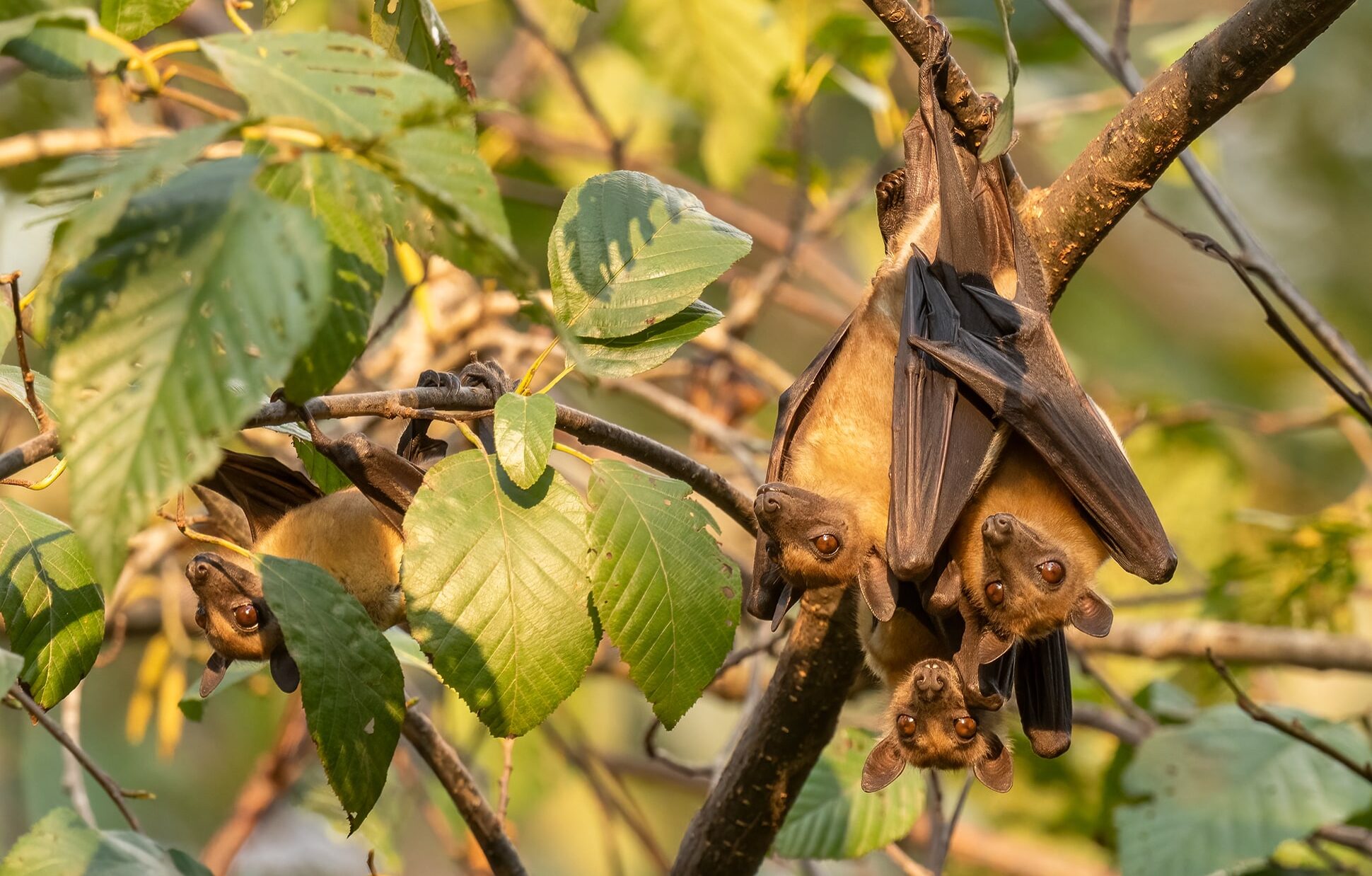
Below, the forest is already alive with movement. Thousands upon thousands of straw-coloured fruit bats (Eidolon helvum) hang densely packed among the branches. In some places, they cluster so tightly that individual bats seem to cling not just to limbs, but to one another, bending branches under their collective weight. The trees themselves appear animated, trembling under the presence of so many wings and bodies.
As dusk deepens, the stillness breaks. A sudden wave of sound rises from the canopy—chattering calls, sharp whistles, and high-pitched shrieks echoing through the forest. Then, almost imperceptibly at first, the bats begin to move.
One by one, small groups release their grip on the trees and take to the air. Within moments, the trickle becomes a torrent. The sky erupts into motion as millions of bats launch into flight, spiraling upward in chaotic harmony. What begins as scattered movement quickly becomes a vast swirling mass, a living storm sweeping across the heavens.
From above the canopy, the spectacle is overwhelming. Streams of bats pour endlessly from the forest, twisting and turning against the fading light. They resemble smoke caught in an updraft, constantly shifting and reshaping as they move in every direction. The air itself seems to vibrate with the sound of countless wings beating in unison.
Despite the apparent chaos, the movement is highly coordinated. The bats navigate the sky with remarkable precision, avoiding collisions as they disperse across vast distances in search of fruit. Their nightly journey plays a crucial ecological role, helping to pollinate trees and disperse seeds across the region’s forests.
For observers at Kasanka, the experience is both humbling and surreal. Standing above the canopy, watching the endless flow of life pour into the sky, it becomes clear that this is not just a spectacle—it is a vital rhythm of nature playing out on an immense scale.
As darkness fully settles over the park and the last traces of daylight vanish, the forest below grows quiet once again. But overhead, the sky remains alive, filled with millions of wings carrying the pulse of the wild into the night.