









Rare 54-Pound Martian Rock Expected to Fetch Over $2 Million at Auction, Alongside 11-Foot Juvenile Dinosaur Skeleton
A rare opportunity for collectors and science enthusiasts alike is making headlines as a 54-pound Martian meteorite and an 11-foot juvenile dinosaur skeleton are set to go under the hammer in an exclusive auction. Organized by renowned auction house Christie’s, the event is drawing global attention for featuring two of the rarest natural history specimens in the world.
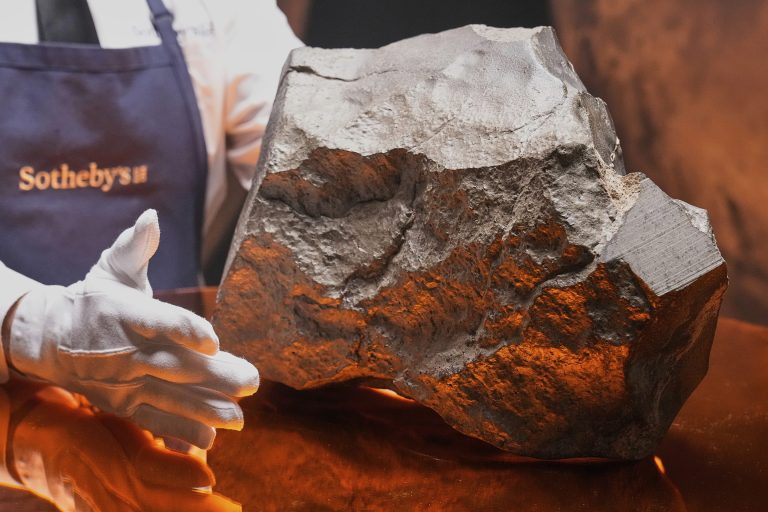
The Martian meteorite, weighing a staggering 54 pounds (around 24.5 kilograms), is believed to be one of the largest pieces of Mars to ever fall to Earth. According to planetary scientists, such Martian meteorites are formed during massive asteroid impacts on Mars that send rock fragments hurtling into space, eventually landing on Earth. What makes this particular specimen even more valuable is its impressive size and the fact that it was found in the Sahara Desert—one of the few locations on Earth where such rocks are discovered and preserved in a relatively intact form. Experts estimate its value could exceed $2 million.
“This is an extraordinary chance for collectors to own a piece of another planet,” said James Hyslop, Head of Science and Natural History at Christie’s. “Martian meteorites are rarer than gold, diamonds, or even moon rocks. This piece is a true relic of our solar system.”
But that’s not the only showstopper in this rare collection. Accompanying the Martian rock is an 11-foot-long juvenile dinosaur skeleton, believed to be from the species Camptosaurus, a plant-eating dinosaur that roamed the Earth during the Late Jurassic period, over 150 million years ago. The skeleton is remarkably well-preserved, giving paleontologists and collectors a window into prehistoric life.
The auction, part of Christie’s “Deep Impact: Martian, Lunar and Other Rare Meteorites” event, will also include several smaller specimens of meteorites, fossils, and rare geologic artifacts. But it’s the Martian rock and the dinosaur skeleton that are expected to be the center of attention—and the highest ticket items.
This high-profile auction reflects the growing interest in natural history collectibles, where rare items are now fetching record-breaking prices. In recent years, dinosaur fossils and meteorites have become highly sought-after by private collectors, museums, and educational institutions. In 2020, a Tyrannosaurus rex skeleton named “Stan” sold for $31.8 million, highlighting the escalating demand in this niche market.
Christie’s has opened both in-person and online bidding to accommodate a wider pool of global collectors. The auction is scheduled to conclude later this month, and early estimates suggest it could break previous records for Martian meteorite sales.
With space exploration and paleontology capturing the imagination of millions around the world, the combination of a Martian meteorite and a juvenile dinosaur in one auction feels like something out of a science fiction novel—except this time, it’s very real.