










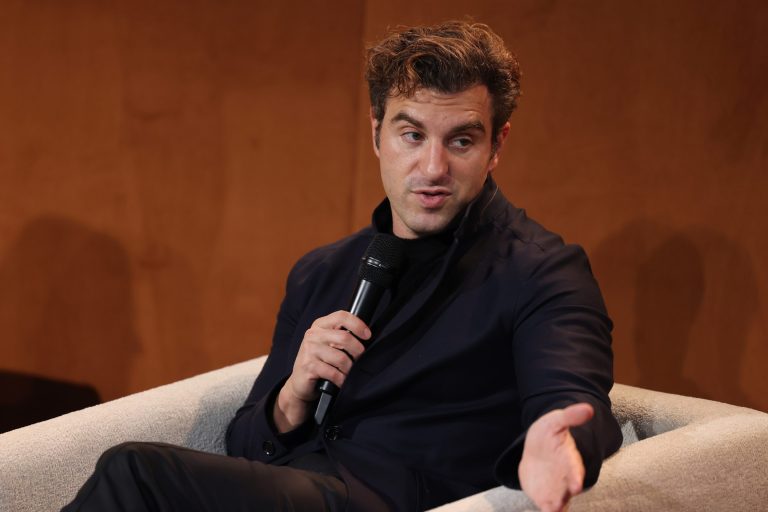
Brian Chesky — The Vision Behind the Question
When you look at the journey of Brian Chesky — from renting out air-mattresses in his apartment to co-founding Airbnb and scaling it into a global hospitality brand — there’s a particular mindset that stands out. That mindset is encapsulated in a deceptively simple question he says every founder should ask: “Why does your company deserve to exist?”.
In this long-form article, we’ll unpack what exactly Chesky’s question reveals about the DNA of successful founders, why it matters deeply in today’s startup ecosystem and how you — as an ambitious founder or aspiring entrepreneur — can apply it to your own venture. Because if you want to emulate his success, it’s not enough to have an idea — you need to believe in it, deeply.
1. The Question That Cuts Through the Noise
Chesky’s mentorship-style advice often zeroes in on this:
“I like to ask entrepreneurs a question: ‘Why does your company deserve to exist?’ … The best kind of generic answer I’ve ever heard is: ‘Because if I don’t do it, no one else will.’”
What makes this question powerful is that it forces founders away from superficial motivations like “we’ll ride the next trend” or “we’ll get rich fast”, and instead into territory of purpose, unique value and irreplaceability. It’s less about what you do and more about why you do it — and what would happen if you didn’t.
This helps uncover key dimensions:
Uniqueness: What can your company do that others can’t? Urgency / Necessity: Is there a genuine gap or need? Ownership / Accountability: If not you, then who?
For founders, simply being excited about a business idea isn’t enough. Chesky suggests you dig deeper: what’s the imprint you want to leave on the world? What change are you uniquely positioned to make?
2. Why the “Deserve to Exist” Test Matters in Founder Success
There are some rigorous reasons why this question is a strong litmus test for long-term startup success:
a) Grounding in Purpose
Startups often begin with high energy, but many fade because the motivation shifts to growth, fundraising or exiting — rather than evolving the mission. By linking to a deeper “why”, the company stays anchored even when the path gets messy.
Chesky himself has repeatedly underscored how founders must stay connected to their origin story and purpose.
b) Differentiation in a Crowded Field
In nearly every market there are many competitors. The reason one startup will stand out is not just execution but a sense of why that resonates. A founder who asks “If I don’t build this, no one else will” is implicitly stating their offering is meaningful and distinctive. That can galvanize team, customers, investors.
c) Long-Term Resilience
When difficulties arise — funding drying up, market shifts, product pivots needed — a strong answer to “why we exist” becomes your internal compass. It helps you decide whether to persevere, pivot or abandon. Chesky’s journey through the 2008 financial crisis, COVID disruptions, and scaling fast shows how purpose enabled resilience.
d) Founder vs Manager Mode
Chesky also uses this question to distinguish founders from mere managers. He argues founders have a deeper, almost parental connection to their venture (“It came from you, it is you.”) which translates into the freedom and impetus to reinvent.
When a company is driven simply by goals and metrics, rather than identity and mission, it risks being “just another” business. The question “why does your company deserve to exist?” helps filter out the companies that might not survive because they are built on weak foundations.
3. What Chesky’s Question Reveals About Founder Readiness
By expecting a solid answer to the “deserve to exist” question, Chesky is implicitly checking for the following attributes in a founder:
• Deep Personal Commitment
If your answer is merely “because the market is big” or “because I saw someone else do it”, you may lack the emotional basis needed to push through adversity. On the other hand, an answer like “because if I don’t build this, no one else will” signals personal ownership and commitment.
• Clarity of Value Proposition
Champions of this question are forced to articulate clearly what their unique contribution is. That clarity helps in defining strategy, product-market fit and internal alignment.
• Readiness for Responsibility and Longevity
A founder motivated by short-term gain may lack the patience and maturity for the marathon of building a company. Chesky’s question reveals whether someone is ready for the long haul — not just the “hype cycle”.
• Understanding of Competitive Advantage
Implicit in the question is the recognition that replication is always possible. So you must know what barrier, insight or position you hold that others don’t. That could be design, community, brand, tech — something that’s uniquely yours.
• Resilience to External Waves
Startups built purely on trends (e.g., “let’s launch the next X app”) are vulnerable when the wave subsides. The “deserve to exist” test ensures the venture is built on more than trend-following; it’s built on intrinsic value.
4. Applying Chesky’s Framework to Your Venture
If you’re a founder (or aspiring one) — here are actionable steps to apply this question to your startup mindset:
Step 1: Write Down Your Answer
Take a sheet of paper (or a digital note) and answer: “Why does my company deserve to exist?”.
Be honest — are you motivated by “this is a great business model” or “this is a world I want to create”? Try to articulate: If we didn’t exist, what would be different about the world? Step 2: Challenge the Answer
Ask follow-up questions:
If I don’t build this, will someone else? What makes us the ones to build it? Is this idea defensible, or just opportunistic? Does our motivation hold up when things go wrong? Step 3: Align Team & Culture
Once you have your “why”, embed it into everything: hiring, product decisions, communications. The stronger the shared sense of “why”, the more aligned your team will be when you scale.
Step 4: Use It to Evaluate Growth Decisions
When new opportunities arise, check them against your “why”:
Does this choice move us closer to our reason for being? Or does it drift us into chasing money or fame?
By using your mission as a filter, you preserve runway, focus and authenticity. Step 5: Revisit Periodically
Your “why” may evolve as the company grows, markets change, and you encounter new realities. But make a habit of revisiting that question — it keeps the company grounded and prevents mission drift.
5. The Broader Implications for Founders & Startups
Chesky isn’t just handing out a nice quote — his question signals broader trends in how startups succeed:
In an age where capital is more constrained, markets more crowded, and tech cycles faster, purpose and differentiation matter more than ever. Investors, employees and users increasingly evaluate companies not just on promises but on authenticity and mission-driven identity. Founder-led companies with deep owner-mindset often outperform pure managerial ones — because they retain agility, passion and focus. Chesky’s “founder mode” ethos highlights this. As many markets approach saturation, the “why” becomes a key competitive advantage. What you sell is often similar to others; why you do it is what sets you apart. 6. Final Thoughts – How to Emulate Chesky’s Approach
If you’re seeking to build a venture with the kind of scope and impact that Brian Chesky achieved with Airbnb, remember this: It’s less about finding the “next big thing” and more about becoming the right thing.
Chesky’s critical question — “Why does your company deserve to exist?” — is not a novelty; it’s a filter. It separates founders who simply want to start something from those who should start something. The difference? The latter have a combination of passion, uniqueness, market need and ownership that can sustain the long climb.
So instead of starting with “How big can we grow?” or “How fast can we raise?”, start with “Why do we need to exist?” If your answer passes that test — you may be ready. If not, it might be time to revisit the idea, redefine your purpose or even pause until you find a deeper one.
For you — building content, exploring business ideas, launching a startup or preparing for your future roles — this is a powerful tool. Lock it in, revisit it often, and let it guide your decisions. Because in the end, success isn’t just about going big — it’s about going right.