










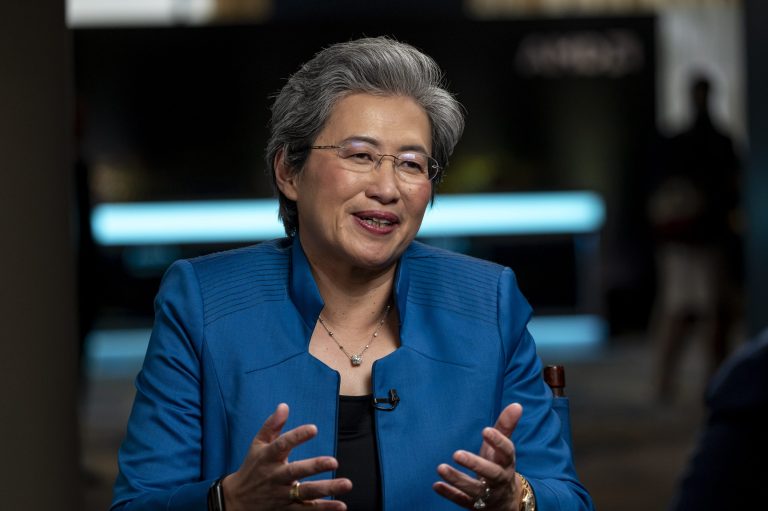
AMD Stock Jumps on OpenAI Deal as Big Tech Moves to Cut Reliance on Nvidia
Advanced Micro Devices (AMD) shares surged this week after reports confirmed that OpenAI is partnering with the chipmaker to diversify its AI hardware supply — a strategic move that signals a broader industry effort by Big Tech to reduce dependency on Nvidia, the current leader in AI chips. The deal marks one of the most significant partnerships in the AI hardware ecosystem this year, highlighting AMD’s growing position as a serious competitor in the artificial intelligence race.
🚀 AMD Shares Rally on Breakthrough Deal
AMD’s stock jumped more than 8% in early trading, driven by investor optimism over the new OpenAI collaboration. Market analysts view this as a validation of AMD’s MI300 series AI chips, which have been touted as the company’s answer to Nvidia’s industry-dominant H100 processors.
For months, AI companies — from startups to tech giants — have struggled to secure enough GPUs to meet the explosive demand for training and running large language models (LLMs). Nvidia has reaped massive profits from this bottleneck, but its near-monopoly has also created supply constraints and high costs.
With OpenAI reportedly working with AMD to integrate and optimize its AI accelerators into data center infrastructure, the announcement positions AMD as a credible second source for the world’s most valuable AI workloads.
💼 Why OpenAI’s Partnership Matters
OpenAI, the creator of ChatGPT, DALL·E, and Sora, is one of the largest consumers of high-performance GPUs globally. Its workloads involve training massive neural networks that require tens of thousands of processors.
Until now, OpenAI’s operations have been heavily reliant on Nvidia GPUs, provided through Microsoft’s Azure cloud platform. By collaborating with AMD, OpenAI gains greater hardware flexibility, cost efficiency, and supply chain stability — three factors that are increasingly critical as AI model sizes and compute demands grow exponentially.
This partnership also reflects Sam Altman’s long-term strategy to build a more sustainable AI infrastructure. In recent interviews, Altman has emphasized that “AI’s growth depends on diversifying chip supply,” and that innovation should not rely on a single vendor — a thinly veiled reference to Nvidia’s current dominance.
🧠 The Tech Behind AMD’s Advantage
AMD’s Instinct MI300X accelerators are the company’s most advanced AI chips yet, combining cutting-edge architecture with improved memory bandwidth and performance per watt. The chip integrates CPU and GPU functions using 3D-stacked technology, allowing for faster model training and inference workloads.
Benchmarks from early adopters have shown that the MI300X can handle certain AI workloads at comparable or even lower energy costs than Nvidia’s H100. If OpenAI’s tests confirm similar performance, it could lead to broader adoption across Microsoft’s Azure and other hyperscale data centers.
AMD CEO Lisa Su has previously stated that the company is targeting a $400 billion AI chip market by 2027. The OpenAI deal is a massive step toward that goal, strengthening AMD’s foothold in enterprise AI and cloud computing.
🏦 Big Tech’s Shift Away from Nvidia
OpenAI isn’t the only player seeking to reduce reliance on Nvidia. Other tech giants have started pursuing multi-supplier strategies to diversify their AI hardware base:
- Google continues to develop its own TPU chips, optimized for internal use.
- Microsoft has designed custom AI chips, codenamed Athena, to power Azure’s AI workloads.
- Amazon Web Services (AWS) is expanding its Trainium and Inferentia chips to handle AI model training and inference for cloud clients.
- Meta Platforms has invested heavily in its in-house chip program, while also reportedly testing AMD accelerators.
This growing movement underscores a fundamental shift in the AI hardware market — the era of Nvidia exclusivity is fading, replaced by a multi-vendor ecosystem where AMD, Intel, and custom silicon designs all compete for share.
📈 Wall Street’s Reaction
Analysts across Wall Street reacted positively to the AMD-OpenAI news, with several raising their price targets for the chipmaker. Some even suggested that the partnership could double AMD’s AI revenue in 2025 if adoption scales across OpenAI and Microsoft data centers.
- Goldman Sachs analysts described the deal as “a critical validation of AMD’s AI strategy.”
- Morgan Stanley called it “a milestone moment” for the company’s AI positioning.
- Retail investors also rallied behind the stock on social platforms, with AMD trending on both X (formerly Twitter) and Reddit’s r/stocks community.
AMD’s current valuation reflects investor confidence in its ability to challenge Nvidia’s grip on the AI chip market — something that seemed nearly impossible just a year ago.
⚙️ The Bigger Picture: AI Hardware Arms Race
The OpenAI-AMD partnership is part of a broader transformation in the global semiconductor landscape. The AI arms race is accelerating, and computing power has become the new oil of the digital economy.
As AI models become more complex — from ChatGPT to multimodal systems like GPT-5 and Sora — demand for efficient, scalable chips will only grow. AMD’s expansion into this space ensures that no single company can dominate the market indefinitely.
Moreover, this competition could drive down GPU prices and speed up innovation, benefiting both developers and enterprises looking to adopt AI tools at scale.
🌍 Strategic Implications
- Diversification Benefits Everyone – By reducing dependence on Nvidia, the industry gains resilience against supply shortages and cost spikes.
- AMD Becomes a True AI Contender – This deal puts AMD firmly on the map as a top-tier AI hardware provider.
- OpenAI Gains Agility – Multiple hardware partners mean more flexibility in scaling infrastructure for ChatGPT and other products.
- Microsoft’s Cloud Wins – Since OpenAI’s infrastructure runs on Azure, Microsoft also benefits from improved hardware sourcing and pricing leverage.
🔮 What Comes Next
With OpenAI and AMD now aligned, investors and analysts are watching for the next milestones:
- Expanded deployment of AMD MI300X chips across Microsoft Azure data centers.
- Possible integration of AMD’s technology into OpenAI’s next-generation models (like GPT-5).
- Increased chip orders signaling broader commercial rollout.
If successful, this collaboration could shift the balance of power in the AI chip industry, giving AMD a long-awaited foothold in a market Nvidia has dominated for nearly a decade.
💬 Final Take
AMD’s surge following its deal with OpenAI isn’t just about stock movement — it’s about symbolic momentum. For years, Nvidia has defined the hardware backbone of artificial intelligence. Now, AMD’s entry marks a turning point: a more competitive, open, and innovative era in AI infrastructure.
As Big Tech giants like OpenAI, Microsoft, and Meta seek alternatives, AMD stands to become the second powerhouse in AI computing, ensuring that the next wave of technological progress is driven not by monopoly, but by competition.
With this deal, AMD isn’t just catching up — it’s officially in the race to power the future of artificial intelligence.