
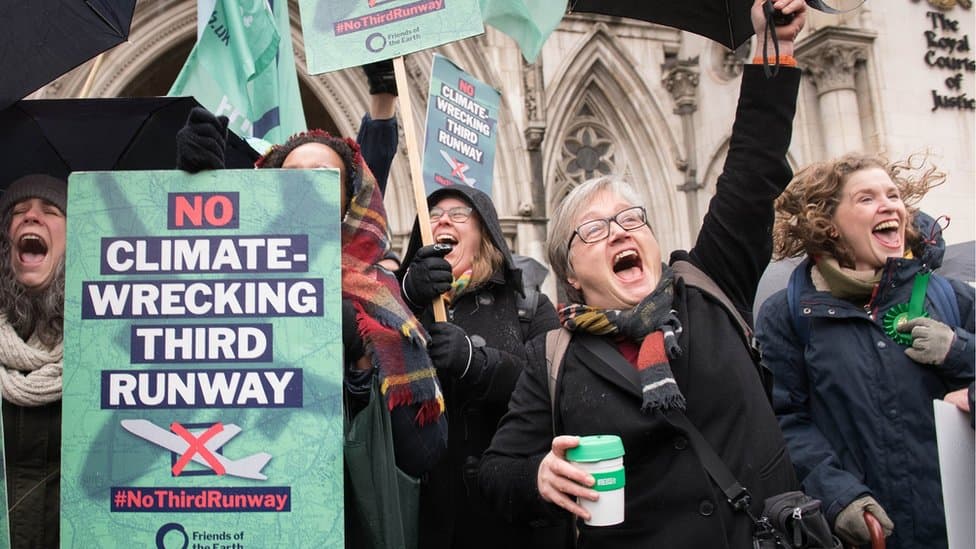
The UK government’s plan to expand Heathrow Airport has come under renewed political pressure after the country’s independent climate advisers warned that a third runway is not currently compatible with Britain’s legally binding climate targets.
The Climate Change Committee (CCC), the government’s independent adviser on climate policy, said on Wednesday that there is currently no credible pathway for Heathrow expansion to remain consistent with the UK’s target of reaching net-zero greenhouse gas emissions by 2050 under existing policies. The warning puts one of the Labour government’s flagship infrastructure and economic-growth projects at the centre of a fresh debate over aviation, investment and climate policy.
The government has backed the expansion of Heathrow as part of its wider strategy to increase economic growth and infrastructure investment. Ministers argue that additional airport capacity could improve international connectivity, support jobs and strengthen Britain’s links with global markets.
The government’s proposed Heathrow Expansion National Policy Statement says any future expansion must satisfy tests covering economic growth, climate change, air quality and noise. The government has said an expanded Heathrow could support more than 60,000 local jobs and generate up to £42 billion in economic benefits.
However, the latest assessment from the CCC has raised questions about whether the aviation sector can expand while Britain simultaneously reduces its overall emissions.
The committee has argued that airlines would need to take much greater responsibility for the emissions associated with additional flights if Heathrow is expanded. That could involve substantially increasing the use of sustainable aviation fuel, improving aircraft efficiency and investing in technologies capable of removing carbon dioxide from the atmosphere.
Sustainable aviation fuel remains a major challenge. Although it is regarded as one of the principal options for reducing aviation emissions, its use remains very limited globally and it is significantly more expensive than conventional jet fuel. Carbon-removal technologies such as direct air capture are also still at an early stage of development.
The CCC has therefore called for a long-term strategy for decarbonising aviation and for the government to ensure that the full cost of reducing aviation emissions is reflected in the sector. The committee has also warned that the government should have contingency plans if key clean-aviation technologies do not develop quickly enough.
The dispute places the Labour government in a difficult policy debate. Ministers have presented Heathrow expansion as an important part of their growth agenda, while climate advisers are warning that the project requires stronger measures to deal with the additional emissions it could generate.
The government has not abandoned the expansion plan. In June, ministers launched a consultation on the framework that would be used to assess future proposals for Heathrow’s third runway. The government said the project would have to be compatible with legally binding climate targets and comply with requirements on air quality and noise.
The consultation itself does not amount to planning permission for the runway. Under the government’s proposed process, a future Heathrow expansion application would still need to go through the statutory planning system and be assessed against the relevant requirements.
The government argues that Heathrow expansion could provide wider economic benefits beyond London and the southeast of England. Ministers say increased airport capacity could improve connections between British businesses and international markets while supporting employment and investment.
Heathrow also argues that the airport is already operating close to its capacity limits and that expansion is needed to maintain Britain’s position as an international aviation hub. The airport says a third runway would create additional routes and increase opportunities for trade, tourism and investment.
The climate debate, however, is likely to remain central as the government moves toward the next stages of the project.
A key question is who should bear the cost of aviation’s transition to lower emissions. The CCC has argued that airlines should be responsible for the emissions associated with increased aviation demand. That could eventually have consequences for ticket prices if airlines pass the cost of cleaner fuels and carbon-removal measures on to passengers.
The issue also raises broader questions about how Britain intends to balance economic growth with its climate commitments. Heathrow is one of the country's most important transport and business hubs, but aviation is among the more difficult sectors to decarbonise because long-distance flights cannot currently be operated at scale using fully zero-emission technologies.
The political significance of the Heathrow debate extends beyond the airport itself. The Labour government has made economic growth a central part of its agenda, and major infrastructure projects have been presented as a way to increase investment and improve productivity. At the same time, the government remains legally committed to achieving net-zero emissions by 2050.
That creates a direct policy challenge: how to increase aviation capacity without undermining the emissions reductions required elsewhere in the economy.
The CCC's intervention does not automatically stop Heathrow expansion. Instead, it increases pressure on ministers to demonstrate how the project could be reconciled with the UK's climate obligations and what additional measures would be required from airlines.
The government has already said that climate compatibility will be one of the tests applied to any future expansion proposal. The consultation framework also allows the climate implications of the project to be considered alongside economic growth, air quality and noise.
For Labour, the Heathrow decision is therefore becoming an important test of how its economic and environmental policies will operate alongside each other. The government wants to increase infrastructure investment and strengthen Britain's international connections, while climate advisers are warning that aviation growth cannot simply be added to the economy without addressing its emissions.
As the Heathrow process moves forward, the debate is likely to focus increasingly on sustainable aviation fuel, carbon removal, airline responsibility and the potential cost of decarbonising air travel.
The immediate political question is no longer simply whether Heathrow should expand. It is how, if expansion proceeds, the government and aviation industry would manage the additional emissions while keeping Britain on track for its 2050 net-zero commitment.
The latest warning from the Climate Change Committee ensures that Heathrow’s third runway will remain one of the most closely watched infrastructure and environmental policy debates in British politics as ministers continue the process toward a final planning decision.