








Trump’s Re-Election Sparks Record Highs in US Markets and Bitcoin Amid Global Trade Concerns
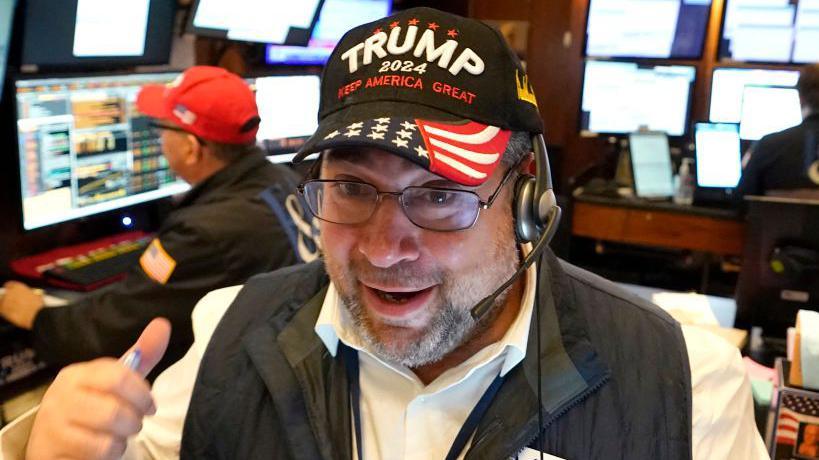
In the wake of Donald Trump’s re-election, US financial markets soared, with Wall Street hitting record highs and the dollar surging in its biggest single-day gain in eight years. Bitcoin also reached unprecedented levels as Trump reiterated his support for the cryptocurrency industry, marking a significant departure from the restrictive approach taken by the Biden administration.
Investors are optimistic about Trump’s plans to cut taxes and raise tariffs, anticipating that these moves could drive up inflation while potentially limiting the Federal Reserve’s rate-cutting path. Higher interest rates could lead to better returns on dollar-based investments, generating excitement across global markets. Major indices surged in the US, with banks particularly benefiting from the stronger dollar. Meanwhile, the dollar itself rose by 1.65% against the pound, euro, and yen.
European markets reacted sharply to the election news. The British pound dropped by 1.16% against the dollar, hitting its lowest level since August. The FTSE 100 index saw gains early in the day before closing slightly lower, reflecting market uncertainty. The euro also plummeted by 1.89% against the dollar, as Germany’s DAX and France’s CAC 40 stock indexes posted declines of 1.14% and 0.51%, respectively. In Asia, Japan’s Nikkei 225 surged by 2.6%, while China’s Shanghai Composite Index dipped slightly, and Hong Kong’s Hang Seng fell by 2.23%.
Bitcoin’s value spiked over $6,600 to an all-time high of $75,999.04, fueled by Trump’s commitment to make the US a “bitcoin superpower.” During his campaign, Trump suggested firing SEC Chair Gary Gensler, who has taken an aggressive stance toward regulating crypto firms, and hinted that Elon Musk could lead an audit on governmental waste. Musk, a prominent crypto advocate and Tesla’s largest shareholder, saw Tesla shares rally by more than 14% as a result.
Amid this surge, Trump’s trade stance has sparked concerns about potential global economic disruptions. His threat to impose tariffs on a broad range of imports has left economists warning of a possible “shock” to the eurozone and UK economies. British Chancellor Rachel Reeves affirmed the UK’s intention to support free trade, emphasizing the shared benefits of open markets. Economists, however, warn that Trump’s policies could slow growth, with the National Institute of Economic and Social Research predicting UK growth could dip from a forecasted 1.2% to 0.4% by 2025. Asia is also on alert, given Trump’s protectionist stance, with additional anxieties around Taiwan, a key producer of essential computer chips.
As markets adapt to Trump’s return, global attention is now turning to the US Federal Reserve. On Thursday, the Fed is set to announce its latest interest rate decision, with investors worldwide watching closely for signs of the central bank’s policy stance under the new administration. Trump’s re-election introduces potential shifts across trade, inflation, and interest rates, as investors and policymakers brace for changes to the global economic landscape.