









Executive views: Nvidia & AMD on China, exports and the new rules
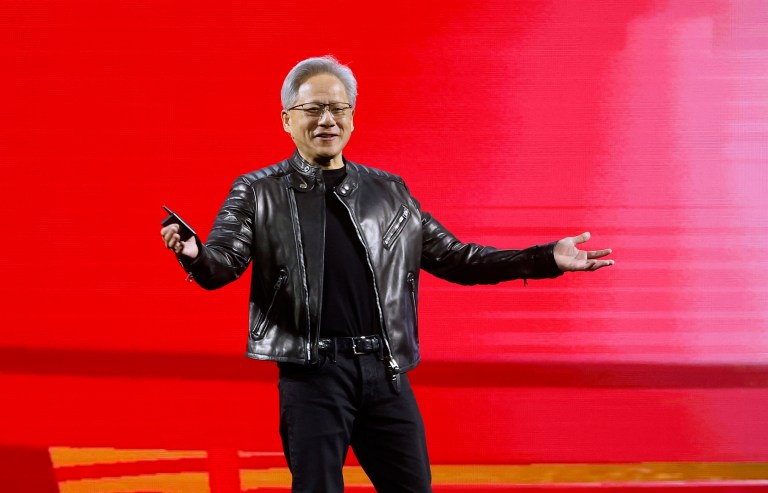
Nvidia CEO Jensen Huang
- Huang has been vocal that recent U.S. export restrictions on advanced AI chips to China are a “failure” of policy: “All along the export control was a failure,” he said at Computex Taipei in May 2025.
- He argues that by imposing curbs, the U.S. has inadvertently strengthened Chinese semiconductor efforts: “Export restrictions spurred China’s innovation and scale,” he told analysts.
- On the China opportunity, Huang emphasises that having access to the “world’s AI developers” (he puts much of them in China) is key for global leadership in tech: “Because there are so many developers there … and we prefer it to be the American technology stack.”
- He has called China “effectively closed” for high-end chips under current export rules — Nvidia is therefore shifting its expectations: he’s flagged that China may be excluded from future revenue forecasts if restrictions persist.
- On China-military linkage, Huang told reporters: “They don’t need Nvidia’s chips … because there is plenty of computing capacity in China already.” In other words: access may be less vital for China than assumed.
AMD CEO Lisa Su
- While direct public quotes from Lisa Su on the exact export-deal are fewer in number, commentary around AMD indicates the company is aware and cautious about the risks of export controls and China exposure. For example, a profile noted that China and Hong Kong accounted for ~15 % of AMD’s 2023 revenue, and that export controls were flagged as a risk.
- AMD’s strategy has been to emphasise global reach: “We want to service the entire world with our chips,” Su is quoted. At the same time, she adds: “I’m certainly a believer in: we want to be the most advanced semiconductor country.”
Key themes and take-aways
1. Market access remains critical — but increasingly constrained.
Huang’s commentary drives home the idea that China isn’t just “another” market — it represents a vast developer base and AI ecosystem. Losing or limiting access means forfeiting more than just sales; it means standing apart from where large pools of innovation happen.
2. Export restrictions may backfire.
Huang argues that restricting U.S. chip exports to China has empowered Chinese firms, accelerated their domestic chip development and reduced U.S. share. Nvidia’s market share in China reportedly fell from ~95 % to ~50 % in recent years. The implication for AMD: while perhaps less exposed, any similar restrictions could erode their China opportunity as well.
3. Governments, not companies, set the rules — companies adapt.
Both Nvidia and AMD face uncertainty driven less by demand and more by policy: export control, licensing, geopolitical rivalry. Nvidia’s estimated Q1 2025 charge of ~$5.5 billion tied to unsold H20 chips is an example. The balance between commercial goals and national security priorities is razor-thin.
4. Strategic messaging for investors and creators.
If you’re tracking chip stocks, tech supply-chains or creating content around tech geopolitics (which many creators are!), this is gold. For example: “Why Nvidia says China business is effectively zero” or “AMD’s China exposure: risk or opportunity?”. These are keyword-rich and timely.
5. Content angles for creators & SEO.
Here are some search-friendly hook suggestions:
- “Nvidia export controls China 2025: what the CEO really thinks”
- “AMD China chip sales risk amid US export restrictions”
- “How US-China chip war is reshaping Nvidia & AMD strategies”
- “Jensen Huang failure export-control comments meaning for investors”
Implications for sectors you’re interested in
- For finance/investor tracking: The chip export saga is not just about chips — it’s about global market access, company risk and geopolitics, all of which matter for large-cap tech investors and those studying structural industry trends.
- For content creation: You (Aparna) can craft short form social reels or longer form video essays on “The China chip divide: Nvidia vs AMD” — tying it to broader themes like leadership, global strategy, tech competition. The niche of “what CEOs really think” is both voyeuristic and insightful for audiences.
- For marketing or training & development: Use these comments to illustrate how leadership messaging aligns (or doesn’t) with reality; how global regulations impact strategy; these are good case-studies for training modules.
What to keep an eye on next
- Will Nvidia or AMD design chips expressly for China under new licensing regimes? Huang hinted at future possibilities.
- Will the U.S. revise its export control policy (or China respond) in a way that changes access? The interplay of policy & technology remains fluid.
- How will Chinese domestic chip players respond and how will that affect market dynamics for Nvidia/AMD?
- For content angles: monitor how Chinese firms adopt non-U.S. chips, which shifts the narrative of “dependency” and “dominance”.