









Kyiv Mourns Young Sisters as Ukraine’s Air Defences Push Back Record Russian Missile Barrage
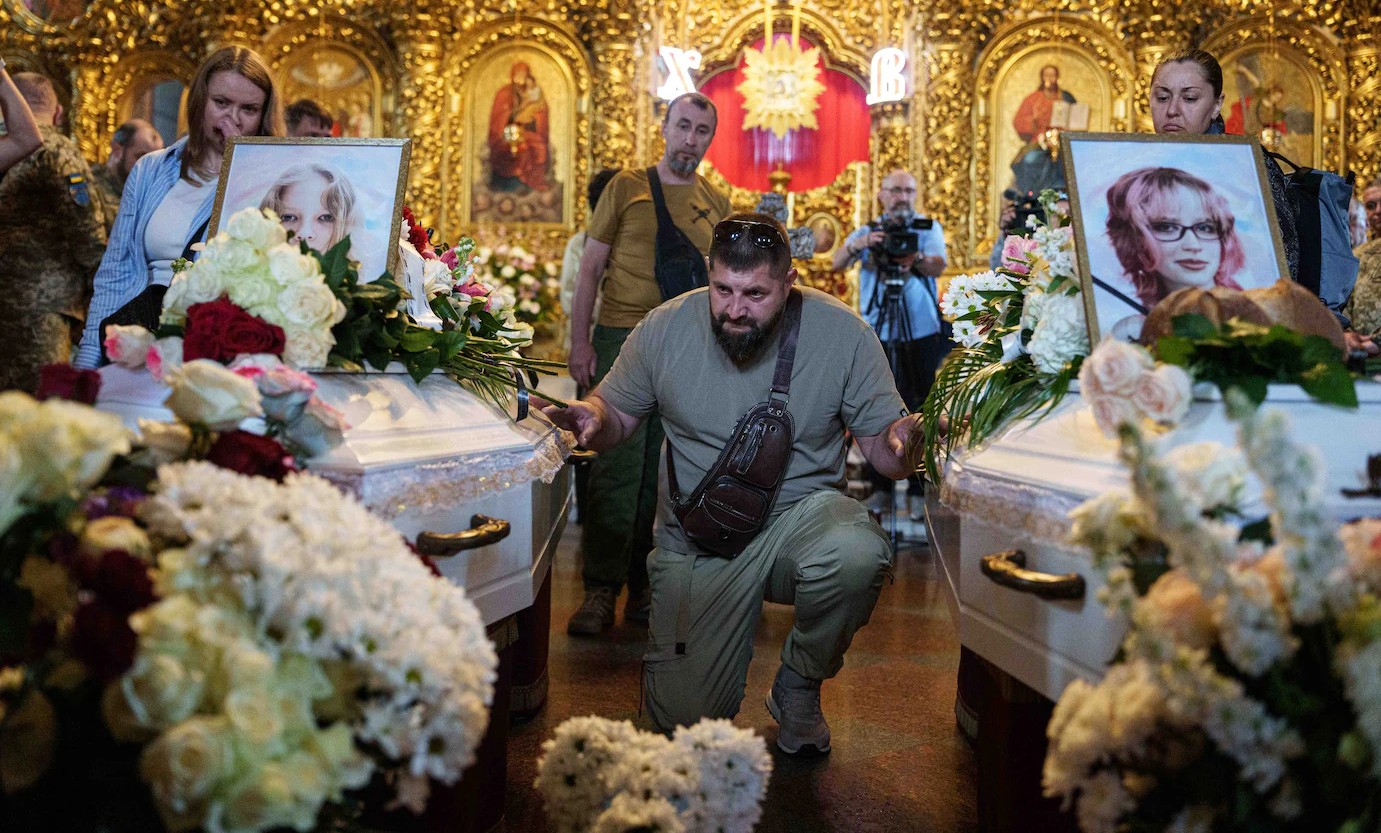
Amid air raid sirens echoing across the capital, Kyiv this week became a place of mourning as family and residents gathered for the funeral of two young sisters killed in a recent Russian strike.
Twelve-year-old Liubava and her 17-year-old sister Vira were among 24 civilians killed when a Russian missile struck their residential building earlier this month, reducing it to rubble. The tragedy has left their mother as the sole surviving member of the immediate family, after their father had already been killed while serving on the front line in the war.
Their deaths have become a stark symbol of the human cost of Russia’s intensified aerial campaign against Ukraine, which officials describe as the largest sustained wave of missile and drone attacks since the start of the war.
According to Ukrainian authorities, Russia launched around 1,500 drones and 56 missiles within a 48-hour period during the latest escalation. The strikes targeted multiple regions, putting immense pressure on air defence systems and forcing civilians to repeatedly take shelter underground as explosions lit up the night sky.
Despite the scale of the assault, Ukrainian officials say the majority of incoming weapons were intercepted. President Volodymyr Zelensky stated that approximately 94% of long-range drones and 73% of missiles were successfully shot down. Officials say this reflects significant improvements in defensive coordination and technology.
In comparison, earlier stages of the conflict saw lower interception rates. Ukrainian forces have gradually strengthened their air defence capabilities through upgraded systems, improved detection networks, and closer integration between military units and command structures.
Lt Col Yuriy Myronenko of Ukraine’s Ministry of Defence said the country has become highly experienced in defending its airspace under constant attack, though he acknowledged that intercepting ballistic missiles remains extremely difficult due to their speed and trajectory.
“We are now, unfortunately, the best in the world,” he said, reflecting both technical progress and the heavy burden of continuous warfare.
While Ukrainian air defences have prevented even greater loss of life, the repeated strikes continue to inflict deep civilian suffering and widespread destruction of residential areas. Entire neighborhoods in multiple cities have been damaged or destroyed, forcing thousands of families to live with constant uncertainty.
For many in Kyiv, the funeral of the two sisters has become more than a private grief — it stands as a reminder of how the war continues to shape everyday life, where moments of resilience exist alongside devastating loss.